





Jewelsmith Featured in MJSA Journal
Thank you
MJSA
In 2018, MJSA Journal, the trade publication of the jewelry manufacturing industry, featured Jewelsmith's goldsmith and designer Molly Hollingsworth in a profile on sustainable practices in the jewelry trade. The piece, "Smoke Doesn't Get in Your Eyes," looks at the small, practical choices behind our shop's environmental commitment: recycled metals, non-toxic solvents, air and water filtration, and an all-LED workshop. Read the full transcript below.
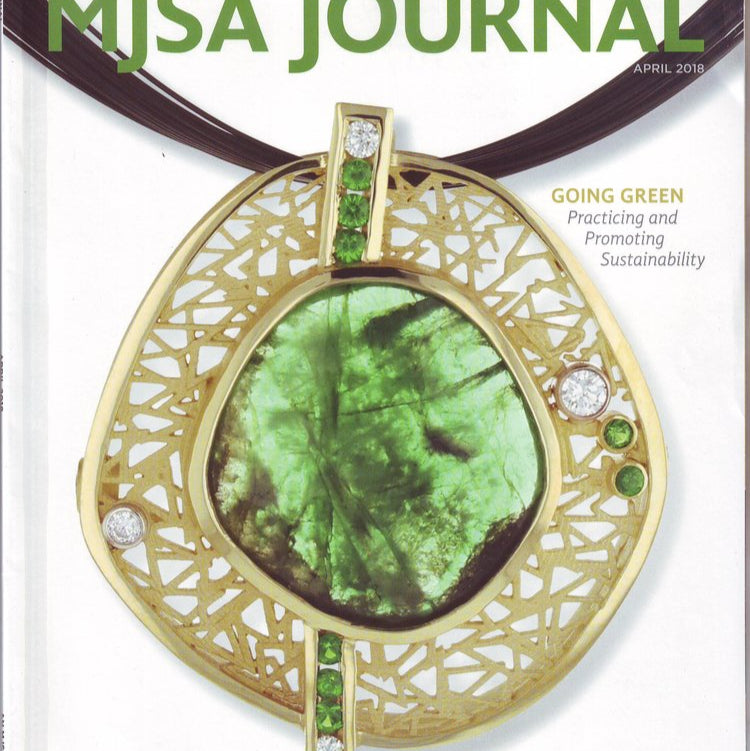
MJSA Journal, April 2018 "Smoke Doesn't Get in Your Eyes"
by Shawna Kulpa
Designer and goldsmith Molly Hollingsworth will be the first to admit that Jewelsmith in Durham, North Carolina, isn't 100% green. Yet. "But we do try to minimize [our impact on the environment] as much as we can," she says.
That's to be expected of a company that describes itself as "passionate about protecting the environment." In addition to featuring conflict-free gemstones in its pieces, Jewelsmith offers diamonds mined in Canada, where mines "pay their workers fair wages, contribute to the mining communities, and maintain higher environmental standards."
That dedication to being green extends into the production shop, where recycling goes beyond just reusing metal and stones.
Whenever a piece of equipment or tool breaks, Hollingsworth and her team put it aside rather than throw it out. Initially they'll try to fix it.
"Often we can," says Hollingsworth. "If not, we keep the broken ones and use the parts to fix other machines when they break." She cites an example of an ultra-sonic cleaner, which has a lot of parts that can go bad. When a switch on a new unit failed, they replaced it with one from an old broken ultrasonic. "It saves us money and we haven't had to throw out a piece of equipment."
The company has also made it a point to avoid harsh solvents in the shop: It doesn't use cyanide, and it no longer does plating work. "We stopped doing things that have really poisonous stuff," Hollingsworth says. "Gold plating solutions and things like that have some pretty nasty stuff in them. It's not worth it for us."
When solvents are needed, she and her team use less toxic ones, such as acetone. "We use it sparingly to soak pearls to remove from posts," says Hollingsworth. "But we'll use it over and over again. One container will last us years."
They've also replaced petroleum-based lubricants for such tasks as punching discs, drawing wire, or lubricating burs. "Whenever possible, we'll use beeswax, mineral oil or wintergreen oil," she says. And while currently they use sodium bisulfate pickle, they've started looking into more natural substitutes. In the meantime, they make sure to take precautions before disposing of the solution.
"We mix in baking soda to neutralize it," says Hollingsworth. "Then we dilute it with tap water."
The shop has two sinks, both of which feature traps to capture metal particles. "Whether we're washing our hands or mopping the floor, all of the water goes through those traps. We try to make sure we're recycling as much as possible."
They also strive to keep the shop's air clean by using a multi-stage fume hood to collect and filter burnout fumes.
"It has a really thick activated carbon filter that works really well," says Hollingsworth. "When we got it, we took a resin from a 3-D printer and set it on fire. The resin is fairly smoky when it burns, and it smells like burning plastic. But with the hood, it completely eliminated all traces of the smell and any smoke. I was initially skeptical, but it did a great job." Maintaining a clean and clear environment is especially important at Jewelsmith because the workshop is directly connected to the company's retail space.
To further enhance that "clear" environment, three years ago they converted all of the halogen and fluorescent lights in the combined 4000 square foot space to LED lighting.
"An LED conversion company did the work," Hollingsworth explains. "All of the fluorescent fixtures had to be changed out as well as some track lighting. IT was a fair amount of work to convert everything." In the three years since the conversion the company has saved money on its electric bills, and they haven't yet had to change a light bulb. "Plus, there's not more buzzing from the fluorescent fixtures."
Continue Shopping